The History of Fog Lane Park - Starting work on the park
Having purchased the land and sorted out rights of way, the Parks and Cemeteries Committee were eager to start laying out the park. On the 16th October 1925, they looked at the tenders submitted by 12 firms to supply and erect wrought iron fencing and gates. They had discussed this when they were planning the park:
‘Although fencing is still a necessary evil in connection with the provision of City pleasure grounds it does not follow that it need be unsightly if this can be avoided. Prior to the War it was more or less customary to enclose parks in Manchester with a so-called unclimbable iron fence from 6’0” to 6’6”in height. As no iron fence is really unclimbable the same end may be attained by using a fence from 4’3” to 4’6” high as by using one 6’0” high. The lower type of iron railing has the decided advantage over the other in that it is both cheaper, and of a less objectionable appearance as it is rather below the vision-level of the average individual.’
The contract was given to Gordon and Blakemore Ltd of Atherton at the cost of £1,700.
The next communication was at the meeting on 5 February 1926. The City Engineer, Bertram Meek forwarded a letter from a Mr F Fenn proposing that a length of water course in Fog Lane Park should be culverted. He showed a plan showing the present watercourse and suggested straightening it and culverting the brook between certain points. The Parks Committee proposed to drain the land on the northerly side of the brook into the existing sewer in Broadway and into a drain recently laid in Sussex Avenue.
Culverting brooks involves enclosing them in a tunnel which runs under the ground and has been happening since the 19th century. Field drainage ditches bringing water from the Burnage Lane area formed two streams, one of which flowed along Fog Lane and through the park.
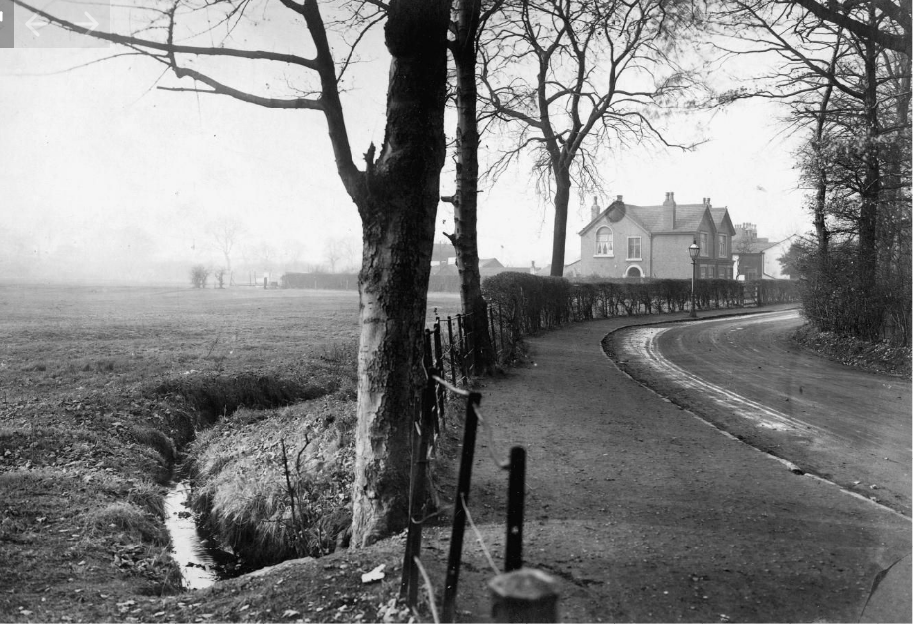
This photo shows the stream running along the side of Fog Lane. Image courtesy of Manchester Libraries
The other stream, which was known as the Ball Brook, flowed through the grounds of Catterick Hall and along the south side of Fog Lane before crossing Fog Lane opposite Fairfax Avenue. It then runs up Fairfax Avenue and meets up with the stream from Fog Lane Park at the back of Ballbrook Court where together they cross the Wilmslow Road and continue on to the Mersey.
These culverts were beautifully made, as can be seen in this photograph below from 1914 which shows the rebuilding of the culvert as it crosses Fog Lane. In the background is the old Toll House, which is still there today.
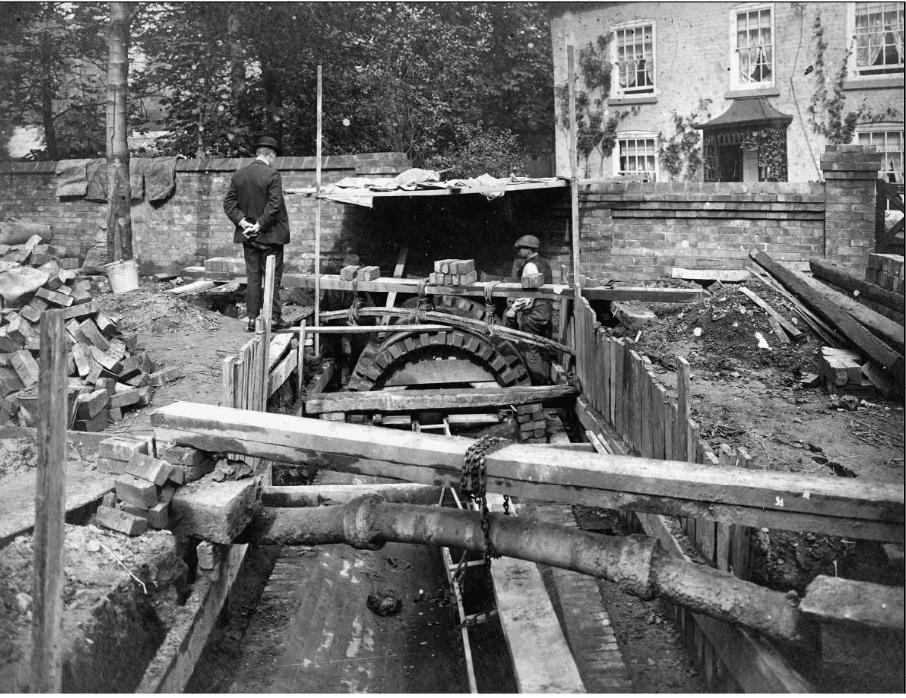
Image courtesy of Manchester Libraries
The City Engineer estimated that the cost of culverting the section indicated would be £400. The Parks Committee approved the plan and forwarded it to the Finance Committee.
[If you want to know more about the hidden rivers of Manchester follow the link to: hidden-manchester.org.uk for a map which shows them all.]
Not all of the brook was culverted, with an open section still running through the park today. Here is the brook below from a photo taken in the 1960s when it was not as overgrown as it is now:
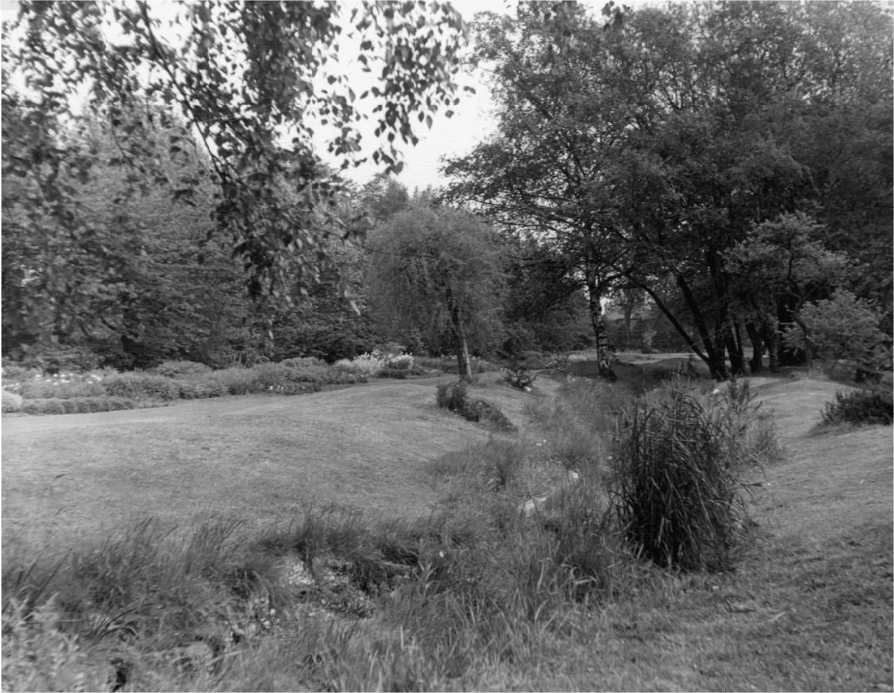
Image courtesy of Manchester Libraries
Everything seems to have been progressing satisfactorily until 30 April 1926, when the Parks Committee received a letter of complaint from Mr Theodore Lord living at 35 Broadway, one of the closest houses to the park. This is the same man who had turned the end of Old Broadway into a garden which had to be removed to allow an entrance into the park:
‘Within the last few days, work has been commenced on that portion of the Fog Lane Open Space which adjoins my house and gardenat 35 Broadway, on its easterly side. I am told that what is there contemplated is a bandstand and tea garden. If my information is correct, I will ask your Committee to reconsider the plan. I consider that a public bandstand and tea garden in the immediate proximity of my house will interfere with the comfortable enjoyment of my premises.
I recognise the Corporation’s powers to provide both bands and tea gardens, but I also conceive it to be the duty of the Corporation to act reasonably. If I am right in my assumption as to the contemplated use of the land in the particular place I have mentioned, then it is my contention that the Corporation will not be acting reasonably, especially having regard to the large acreage of the open space, and the opportunities of providing the amusements and facilities elsewhere.’
The Parks Committee resolved that Mr Pettigrew, the General Superintendent of Parks, should interview Mr Lord and explain to him the Committee’s views in regard to this matter. Mr Pettigrew reported back to the Committee at the next meeting on 11 June 1926:
‘He explained to Mr Lord the proposals of the Parks Committee with reference to the provision of a sunken Bandstand and the layout of the park adjoining Broadway. He stated that he was of the opinion that Mr Lord was under a misapprehension, and had not taken into consideration the fact that the Band would be accommodated in the Sunken Bandstand and that there would be a wide shrubbery which would deaden the sounds reaching the houses adjoining the park in Broadway. He assured Mr Lord that every precaution would be taken to prevent the Band Performance from being in any way a nuisance.
Mr Lord was perfectly frank and stated that while he realised that the Corporation had certain powers he was going to take every opportunity of preventing them from spoiling, what he considered, the restfulness of his own home, and should he consider that he was in any way inconvenienced, he would immediately take steps in the Law Courts for an injunction to prevent the playing of music in the vicinity of Broadway.
The General Superintendent thanked him for his frank statement and said that he would on his side do everything he could to check him taking such a step by planting trees closely together in the shrubbery adjoining the houses so as to hide out the view and minimise any sounds which may come from the park.’
What Mr Lord thought of the new bandstand (shown below), when it was finally erected, we will never know.
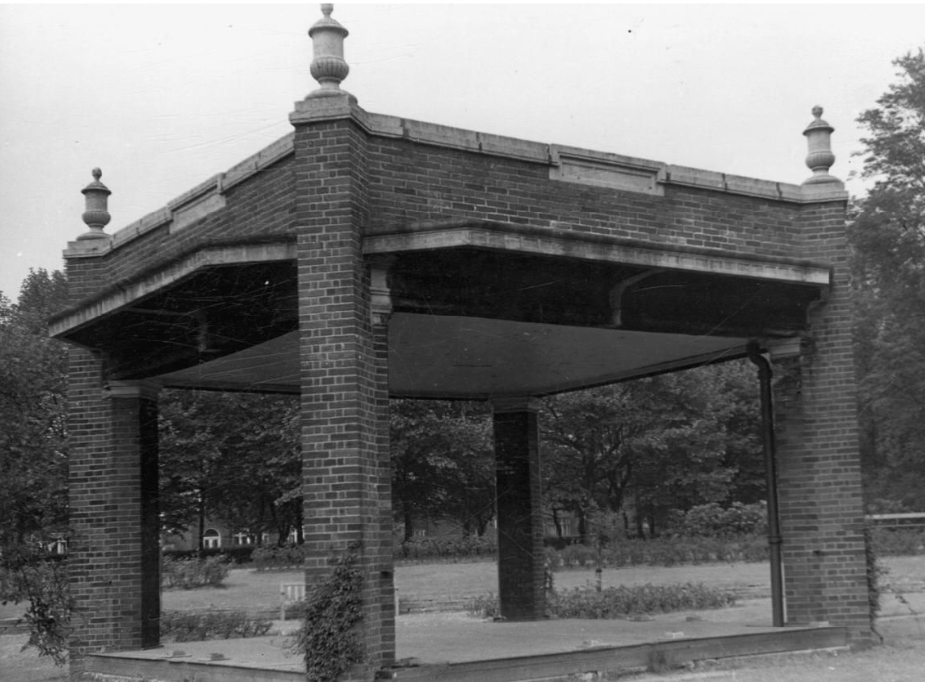
Image courtesy of Manchester Libraries