The History of Fog Lane Park - Consternation on Broadway
Having agreed the plan for Fog Lane Park, the Parks and Cemeteries Committee were eager for the work to begin. The area around the park was undergoing massive changes at this time, with building work having already commenced on the estate grounds of Catterick Hall, just off Fog Lane. The Corporation was building 250 council houses on the site and were also planning to open a new road through the estate which was to become Parrs Wood Road.
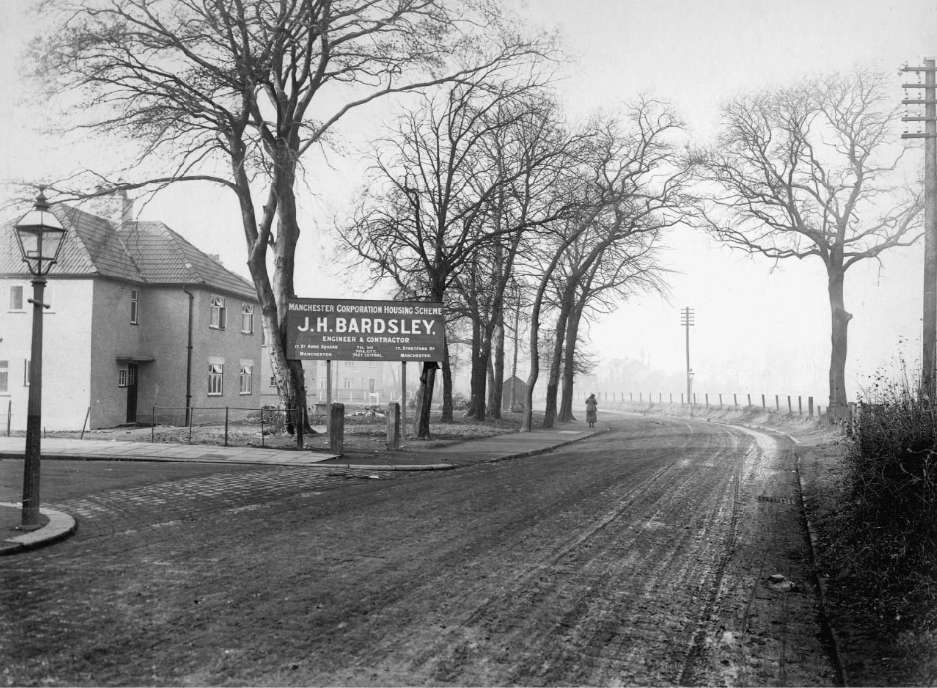
Image courtesy of Manchester Libraries
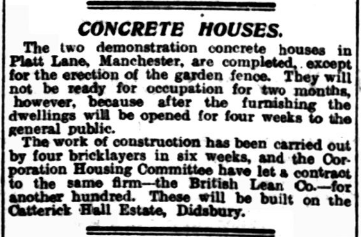
In this image, the house on the left is 218 Fog Lane at the corner of Ellesmere Road. The houses were built using a new construction method using cement blocks because there were not enough skilled bricklayers after the First World War.
MEN 1 Oct 1920
Parrs Wood Road would eventually cross over roughly at the place where the figure can be seen and this formed the eastern edge of the park.
The Committee having approved the plans for the park, Mr Pettigrew came back to the next meeting on 29 May 1925 with fully costed estimates for the work on the park. He stated that:
‘If unemployed labour were used for the purpose, he estimates that the cost would be £28,197 of which £17,059 would be spent on Labour, representing an equivalent of 6 months work for 276 men.’
They would also need to provide the buildings, as stated in the plan, but now, as well as the conveniences, dressing rooms, tennis and bowls pavilion, shelters and bandstand, these also included a refreshment room and pavilion and a caretaker’s house with tool shed, store house and stable. The City Architect estimated that the total cost of these buildings would be £12,300. The Parks and Cemeteries Committee approved the estimate of £28,197 and forwarded it to the Works For Unemployment Special Committee. On 18 September it was resolved that the Corporation would apply for the funding from the Ministry of Health under the Public Health Acts.
At the same meeting, the Committee received a petition from the residents of Broadway (known as Old Broadway today). The letter was addressed to ‘The Right Honourable the Lord Mayor and the Aldermen and Councillors of the City of Manchester’:
‘My Lord and Gentlemen,
We the undersigned Petitioners are informed that it is the intention of your Corporation to construct a public Park and recreation grounds in the immediate vicinity of Broadway aforesaid and that it is intended to open a roadway through Broadway and to convert the same into a public thoroughfare for the purpose of giving means of entering the said Park and recreation grounds from Wilmslow Road aforesaid.’
The residents weren’t happy about this and gave various reasons. First of all, they pointed out that for the past 15 years they had been maintaining the road at no cost to the Corporation. They also observed that to extend the road as far as the park would require the expenditure of a large sum of money. But more importantly for them;
‘The consequences of turning Broadway into a public thoroughfare would be most injurious to the inhabitants thereof as well as to your Corporation for the immediate result would undoubtedly be a serious depreciation in the value of their property.’
They went on to suggest that it would be much more convenient for the public to walk along Fog Lane and enter the park at the main entrance there. They concluded their petition:
‘Your petitioners chose Broadway for residential purposes because after leading strenuous lives in their various profession and vocations they needed the rest and quietude which that locality at present affords and which is so necessary to the preservation of their health but which advantages would be entirely lost to them if the said private roadway were opened out as aforesaid.
For the above mentioned reasons your Petitioners respectfully ask that the gracious consideration of your Lordship and the Corporation should be given to the prayer of this Petition and that it will be assented to.’
Unfortunately for the residents, they were informed by the Town Clerk, Mr F M Heath, that there was already a public right of way along Broadway and that;
‘it is not the intention [of the Corporation] to use the entrance for vehicular traffic but only for the use of pedestrians’
It was also pointed out to T.E.Donne Esq, of 36 Broadway and Theodore Lord Esq, of 35 Broadway that the land at the end of Broadway, which they had turned into a garden, did not belong to them and needed to be cleared to enable the Corporation to complete the roadway to the entrance of the park. At the same meeting, the City Surveyor showed them the proposed plan for the entrance at Broadway and this was approved by the Committee.
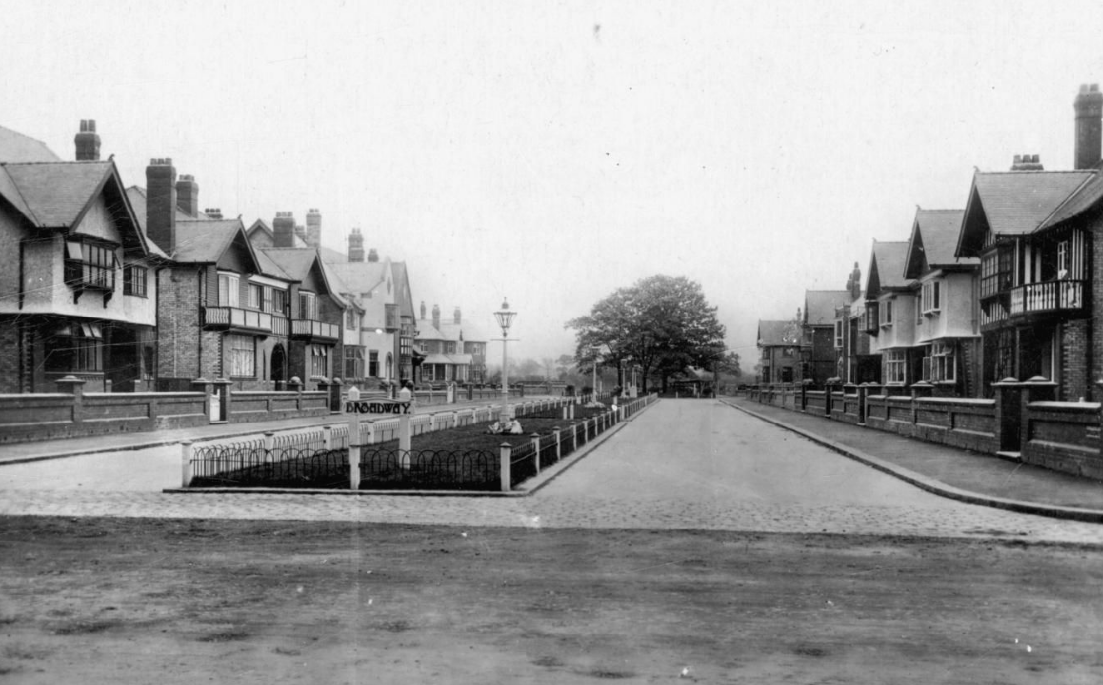
Image courtesy of Manchester Libraries
View down Old Broadway towards what would later be the entrance to the park (1920)