The History of Fog Lane Park - Getting started 1924-5
By the early years of the twentieth century, Withington and Burnage were both growing rapidly. Withington had a population of 1,492 in 1851, but by 1901 it had risen to 20,022. Burnage had been a sleepy village with a population of 563 in 1851, described by George Bernard Shaw in 1894 as: ‘the prettiest village anywhere near Manchester’. It was still quite small in 1901 with a population of 1,892, but things were beginning to change. With the coming of the railway and the opening of the station at Burnage in 1910, followed by the building of a new road, Kingsway, which began in the mid-1920s, it was getting much easier to move around. Better transport links encouraged more house building in the area, and suddenly the fields and farms were being gobbled up by housing development.
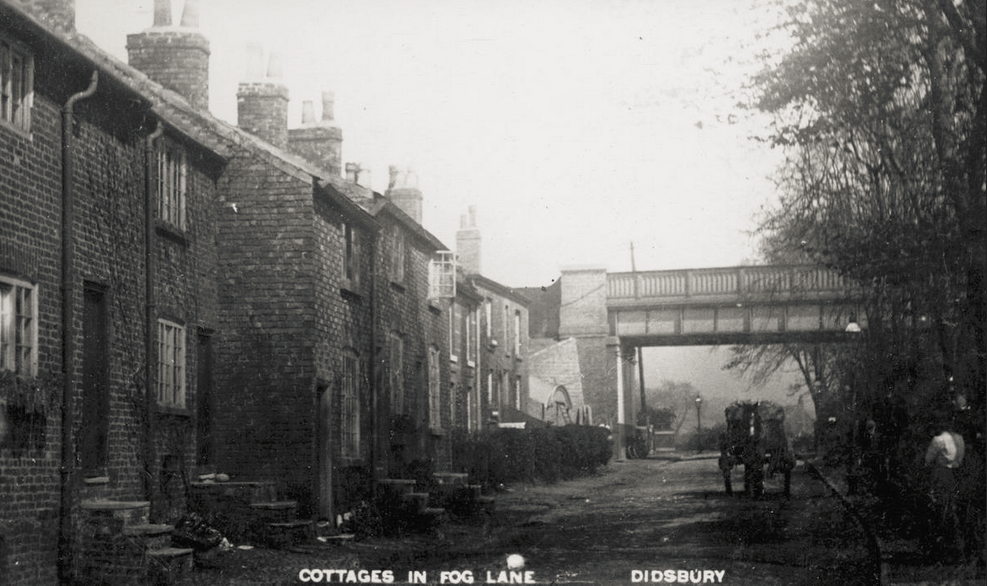
View of Fog Lane and Burnage railway bridge. Image courtesy of Manchester Libraries
It was at this point that the council decided that it should look for some suitable land to turn into a park before all the green space was used up for housing.
The first mention of their plans is made in the Parks and Cemeteries Committee Minutes on 3 October 1924 where they included a copy of a letter from the Ministry of Health, Whitehall dated 19 Sept 1924 which sanctioned:
‘the borrowing by the Council of the City of Manchester of the sum of £12,066 in connection with the acquisition of land for open spaces at Fog Lane and Didsbury.’
This money had to be repaid with interest within 60 years. The Committee quickly got on with this, and at the meeting on 31 October Mr Pettigrew, General Superintendent of The Parks and Cemeteries Committee was able to report that:
‘Most of this land has now been purchased by the Town Planning Committee and is ready to be taken over. Much of the work in the laying out of this land would be ideal work for the relief of unemployment during the winter of 1925’
Things seem to have gone quiet for a while after this, apart from serving a notice to quit on Mr W. L. Kelsall of Whitehall Farm, Didsbury who held some of the land on an agricultural tenancy. There was also some discussion about giving notice to a group of allotment holders who used some of the land, in order that it could be cleared for the start of work in the Autumn of 1925.
On 30 March 1925 the Committee received another letter from Westminster, this time from the Unemployment Grants Committee. In the letter, they thanked the Local Authorities for providing work for the unemployed over the last four winters through extensive public works and asked them to consider further public works for the coming winter. They asked Local Authorities to:
‘Submit comprehensive proposals for their localities in the form of definite schemes accompanied by the usual plans and details…if possible, by the 1st August’
At the meeting on 1 May, the General Superintendent, Mr Pettigrew was asked to come up with a scheme, which he quickly brought to the next meeting on 15 May. He began his report with a description of the site stating:
‘the land at Fog Lane is in every way ideal. The surface of the land is on the whole quite level…..which will enable your Committee to set out playing pitches at a minimum of expenditure. The soil, while in places inclined to be damp and even marshy, is, generally speaking, of a free sandy nature which ought to be easily worked and kept in a good condition, provided the land is thoroughly drained before it is laid out.’
Mr Pettigrew then produced a plan of the proposed park, which unfortunately, is now lost to us. He explained that:
‘The greater part of the area will be devoted to open air sport and amusement. While the ornamental features have not been overlooked these have been confined to the boundaries of the park and to portions of the land which would otherwise have been of little use for recreative purposes.’
He then went on to list the 13 football and hockey pitches, some of which would be used as cricket pitches in the summer, also 2 bowling greens, 2 putting greens and 24 tennis courts, of which 4 would be grass and the remainder shale. There would also be a bandstand. He then went on to describe the ornamental gardens:
‘As the atmospheric conditions are about the best in Manchester the General Superintendent feels that full advantage ought to be taken of this fact and he has therefore contrived that the ornamental portion of the design shall be made worthy of the district. With this object in view, the most has been made of the natural features of such portions of the ground as are unfitted for games and pastimes. A pond already in existence may be made a beautiful and interesting object by having its edges furnished with moisture loving plants and the water planted with hardy aquatics. A stretch of damp boggy ground abutting on the pond could be turned to good account if bog and peat loving plants were grown in profusion on it.’
Finally, he went on to list the buildings which would be needed once the laying out of the park had been completed:
2 sets of lavatory conveniences
2 dressing rooms for footballers etc
1 combined bowl house and tennis pavilion
2 public shelters
1 bandstand
The Committee approved the plans and asked Mr Pettigrew to prepare the necessary estimates for the next meeting.
That same evening there was a small piece in the Manchester Evening News about the proposed new park.
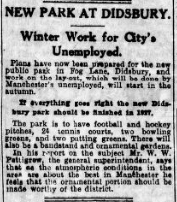
MEN 15 May 1925