The History of Fog Lane Park - Farewell to Mr Pettigrew
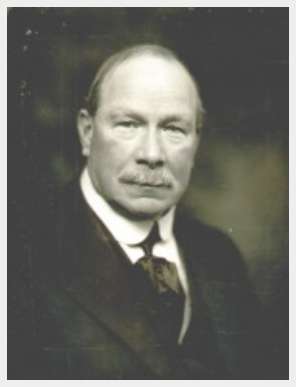
William Wallace Pettigrew Courtesy of Roath Local History Society
In February 1932, Mr Pettigrew, General Superintendent of the Parks Department, announced that he intended to retire. I am sure that the Parks and Cemeteries Committee must have been very sad to see him go, as he had been responsible for a transformation in the city’s approach to municipal green spaces.
His career is so remarkable and had such an influence on the design of municipal parks, that I thought that it was worth giving a short life history, for which I am indebted to articles produced by the Roath Local History Society and English Heritage.
William Wallace Pettigrew was born in Scotland in 1867. In 1873, his father moved the family from Scotland down to Cardiff, where he took up the post of Head Gardener of Cardiff Castle transforming the setting of the castle and deer park into one of the most fashionable, productive and innovative estates of the day. William Wallace worked alongside his father from the age of 16, before training in horticulture at Kew Gardens in London. After his formal training at Kew, he was appointed as gardener at Culzean Castle, Ayrshire and in 1891 he came back to Cardiff as Head Gardener for Cardiff Corporation where he oversaw the development of Roath Park, which opened on the 23rd June 1894. He then went on to develop Cardiff’s Grange Gardens, Victoria Park and Cathays Park.
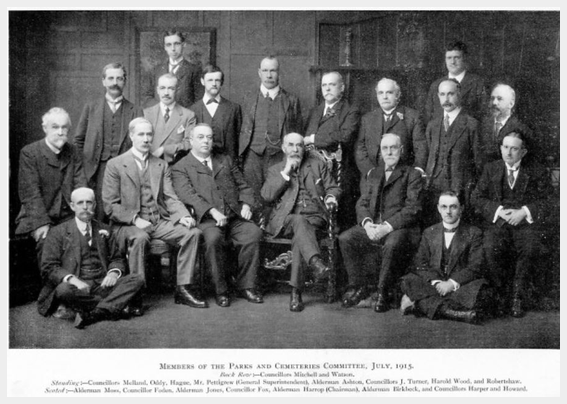
Members of the Parks and Cemeteries Committee July 1915 Courtesy of Roath Local History Society
William Pettigrew is standing in the middle, behind the man in the chair.
In 1915, William Pettigrew was appointed as Chief Parks Officer in Manchester, where he remained until his retirement in 1932. During the First World War, he served as the Chief Officer of the Foodstuffs Committee, using Manchester’s parks for food production and arranging for conscientious objectors to help grow produce, with the men housed at Platt Hall. He also conducted a pioneering study on the detrimental effects of heavy air pollution on city-centre parks, focusing closely on Philips Park. In 1926, he was awarded the prestigious Victoria Medal of Honour (VMH) by the Royal Horticultural Society and also served as the President of the Institute of Park and Recreation Administration between 1926 and 1929. He wrote two books; The City Of Manchester Handbook of the City Parks and Recreation Grounds (1929) and Municipal Parks: Layout, Management and Administration (1937), which was the first text book on public parks administration.
After retirement, Mr Pettigrew and his wife moved to Worthing in Sussex, where he continued to write and lecture on park matters. He died in early 1947, at 80 years of age, just three weeks after his wife Ruth.
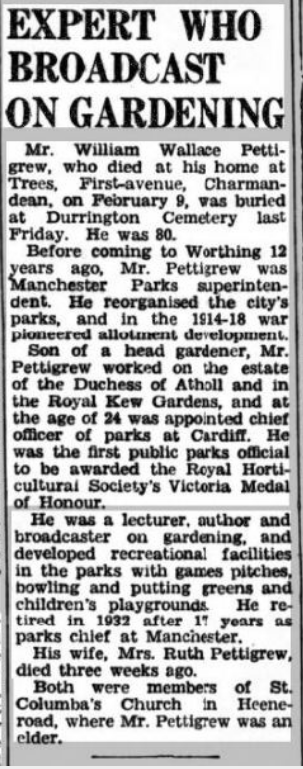
Newspaper obituary Courtesy of Roath Local History Society
Such a renowned Superintendent was going to be hard to replace, but on the 23rd February 1932 a special ‘Sub Committee re Appointment of General Superintendent’ was formed. It consisted of Alderman Melland (Chair), Aldermen Fox and Oddy and Councillors H.F.Robinson and Watson. They came up with the following advertisement:
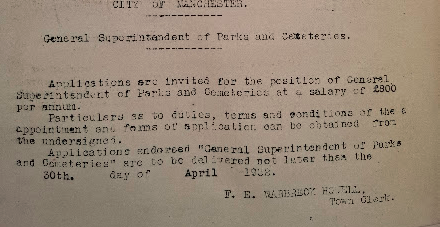
It is interesting to note that the salary offered is £800, as opposed to the £980 that Mr Pettigrew was receiving after reductions. This was possibly due to the cut-backs. Having advertised the post, interviews were held and a shortlist was produced of three candidates:
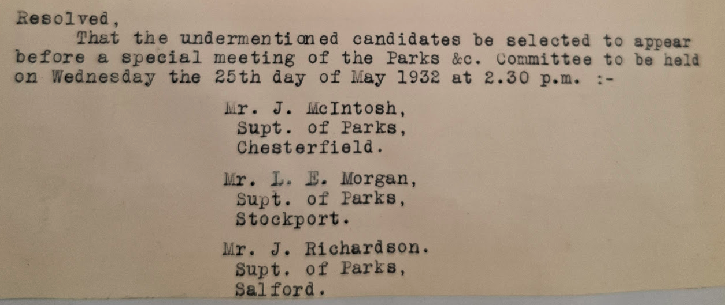
Finally, it was Mr J Richardson, Superintendent of Parks, Salford who was chosen to replace Mr Pettigrew, who finally retired in Oct 1932. At that meeting the Committee resolved unanimously:
‘That this Committee desires to replace on record it’s high appreciation of the valuable services rendered to this Department of the Corporation during the past seventeen years by Mr W W Pettigrew as General superintendent of Parks and Cemeteries. During this period the parks acreage has increased by approximately 450 acres and the lay-out and design of the new parks and recreation grounds which have been formed under his direction, as well as the great improvements and alterations he has effected in the older parks during his tenure of office, will prove a lasting memory of his efficiency as a master of his craft. His fame has not been confined to Manchester alone as on several occasions he has been honoured nationally, and the Committee recall with pride the honour of VMH which was bestowed upon him by the Royal Horticultural Society.
The Committee hopes and trusts that he will long be spared to enjoy a well earned retirement.’
This was followed by a letter from Mr Pettigrew on 7 Dec 1932:
‘Will you kindly convey to the members of the Parks Committee my sincere thanks for the all to flattering terms of the resolution that you passed at your meeting on 28 October last, regarding my services in connection with the Manchester Parks. I must also at the same time thank you for the gift of a copy of this resolution (engrossed on vellum) which was handed to me on the 5th instant by Mr Richardson.
Permit me to take this opportunity of thanking the whole of your Committee for the outstanding courtesy and sympathetic consideration you have consistently shown to me during the seventeen years that I have had the honour of serving you. No official could possibly have had a more considerate or a more encouraging body of gentlemen to serve under than it has been my good fortune to do in Manchester. This fact has made my work at all times a joy to me, and undoubtedly has been the means of bringing the best out of me.’
Meanwhile, the Parks Department were having to make cutbacks to expenditure in order to bring spending down from£162,044 to £150,000. This included not building a bowl house at Didsbury Park or dressing accommodation at Ladybarn. At Fog Lane Park they had to reduce the spending on repairs to paths from £125 to £75.
At the meeting on 27 May 1932 there was discussion about whether the Parks Department could afford to purchase tulips and other bulbs for the Spring display in 1933:
‘the present rate of exchange now operating in Holland will cause prices to rise considerably higher than they have been of late. With the reduced finances of the Department under the rationing scheme, it is a question whether or not you would be justified this year in spending on bulbs even the limited amount you did last season.’
In the end, it was decided to adopt the policy which was used during the First World War, when tulip bulbs were only bought for Philips Park and the Cemetery. Spring bedding would be grown on at Carrington in frames ready for planting out just before they came into flower.
‘Although these plants would not make the brilliant display produced by tulips, they would nevertheless give a bright and cheerful appearance to the open spaces at a period when such places would otherwise look dull and uninteresting.’
On 9th August 1932, the Parks Department received a letter from the National Society of Non-Smokers:
‘ I am requested by the above Society to urge that seats for the non-smoking public should be provided in the Parks. Smokers there, are in a decided minority, yet they are allowed to make themselves objectionable to others, by the unlimited scope at their disposal for practising the habit. At open air concerts, Smokers seats should be placed to the leeward, so that those going to the parks to obtain breathing space, may get unflavoured air.
When seated in a park on a hot day, it is to many extremely unpleasant to find a neighbour puffing smoke in their direction.’
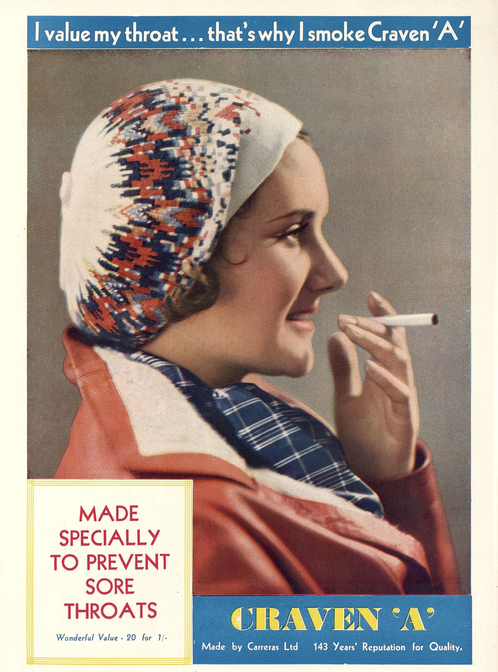
Britannia and Eve 1931
Smoking cigarettes, as opposed to pipes, had increased dramatically since the First World War, when cigarettes were provided to the troops in their ration packs to calm nerves and boost morale. They were quick to light and easy to carry in muddy conditions and became an informal currency used to trade for food, haircuts and favours among the troops. Some cigarettes were even marketed as having a health benefit, as this 1931 advert above from Britannia and Eve magazine shows. As a result, cigarette consumption tripled globally between 1914 and 1919. Having considered the request from the Society of Non-Smokers, it was decided to take no action in this matter.
The annual report for the Parks department was reviewed at the meeting on 30th Sept 1932. There were 377 band performances given in the parks over the course of the year, but attendances were down. At the nine parks with band enclosures, there were 234 performances attended by 59,033 people, compared to 265 performances attended by 105,059 persons in 1931. Concert Party performances were also down and made a loss of £182. As a result, the Parks Department resolved that:
’having regard to the loss that has been sustained during the past season, no concert parties be engaged for the forthcoming season.’
© 2026 Friends of Fog Lane Park. All Rights Reserved.