The History of Fog Lane Park - Fog Lane Park in the early 1930s
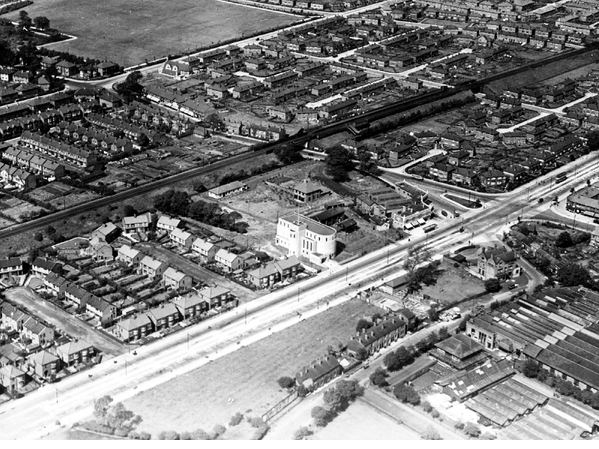
This is the earliest photo that I can find of Fog Lane Park. It was taken on 31 August 1932 and is an aerial shot showing Kingsway, with St. Nicholas’ Church in the centre and the Reynold Chains factory in the bottom right-hand corner, where Tesco is now. Part of Fog Lane Park is just visible in the top left-hand corner. You can’t see much of the park, just the football fields, which don’t appear to have their goal posts up yet for the autumn season. There are no signs of any football changing rooms, although there appears to be a building on the bend of the path, just before it goes out of the photo. One thing that is very noticeable, is the size of the trees growing along the side of the park which faces onto Parrs Wood Road, which appear to be tiny. Also noticeable is that there appears to be a footpath running along that side of the park. We can also see that by 1932, houses have been built on Parkville Road, overlooking the park, and as this advertisement from the Manchester Evening News shows, the park was now regarded as a prime location.
Image courtesy of Manchester Libraries
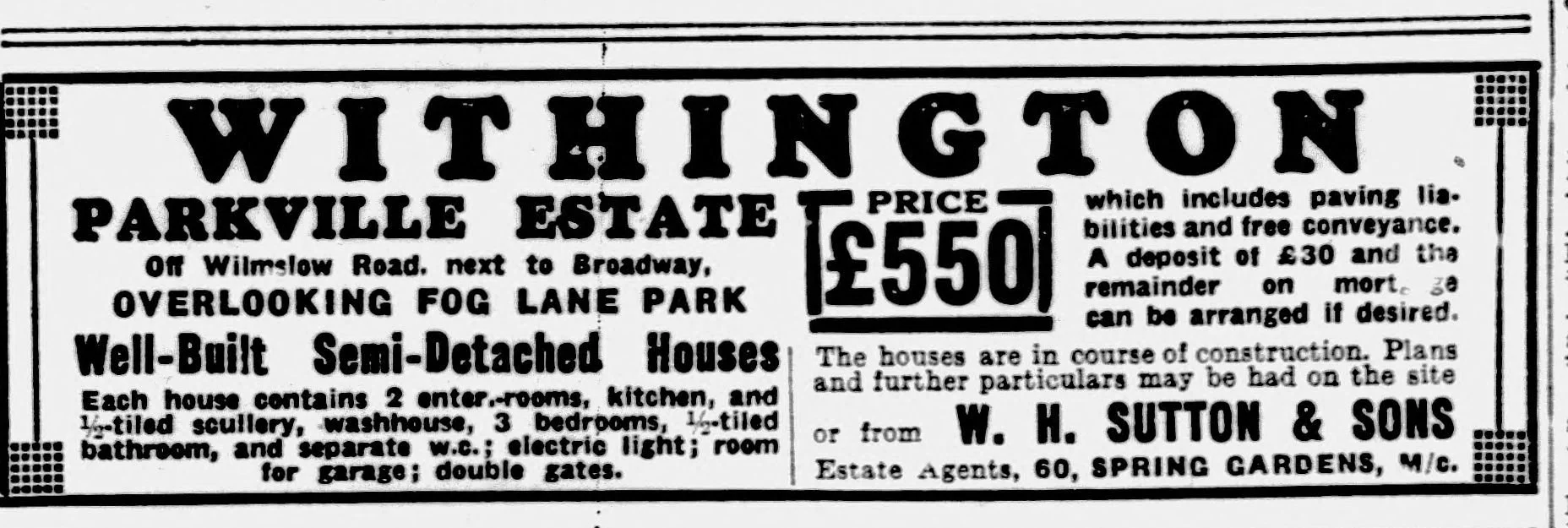
MEN 12April 1935
On 20th March 1930, the Parks Superintendent received a letter from Parrs Wood Road Congregational Church. They were holding a Whit Sunday Procession together with St Nicholas and Burnage Wesleyan Schools on June 8th and wanted to finish the procession with a short service in Fog Lane Park at the ‘Band Enclosure’: ‘We are hoping to secure the services of the Burnage Prize Band or some other band to lead the singing and trust that your permit will include this.’
At the next meeting of the Parks Committee, it was agreed that: ‘the application now made be granted and that the applicants be informed that a charge of £5 will be made in the event of the Bandstand being used for the occasion.’
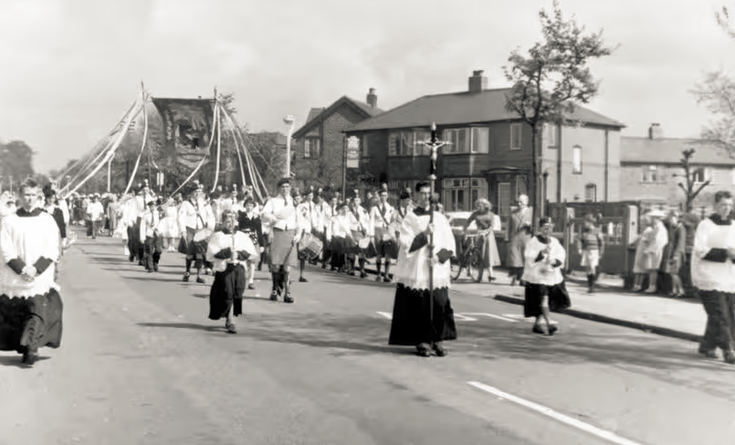
Image courtesy of Manchester Libraries
Whit Sunday processions in the 1930s were often huge processions involving Sunday school children and church members marching in new summer clothes with young girls traditionally dressed in white. They processed along the streets carrying heavy, ornate embroidered church banners and accompanied by local brass bands and choirs. This was followed by open-air hymn singing. The event in Fog Lane Park appears to have been very successful, as it was repeated in the following year. However, the Sunday schools built a temporary platform rather than paying £5 for the use of the Bandstand. J.A. Wilson Turner, the Sunday School Secretary, estimated that:
‘about 5/600 persons, mostly young children, will take part in the procession: so that the number attending the service would be considerably in excess of that number.’
It doesn’t sound like the bandstand area would have been big enough to accommodate everyone.
In February 1931, Mr. Mackintosh, the Head Gardener of Birchfields and Supervisor of Withington and Didsbury, was appointed Superintendent of the Parks and Cemeteries at Chesterfield. This made him the fifth member of Manchester Parks and Cemeteries Department to be appointed as a Superintendent in the past two years, the others taking up the same position at Preston, Southport, Shrewsbury and Fleetwood parks. The Parks Department were also very proud of their reputation for training young gardeners who went on to achieve great things at RHS Wisley, Hyde Park, the Royal Gardens, Kew and the Royal Botanic Gardens, Edinburgh. As Mr Pettigrew stated:
‘It is gratifying to know that all these lads are giving entire satisfaction to their employers with the result that provided vacancies exist there is no difficulty in getting apprentices from the Manchester Parks Department placed in some of the best Horticultural Establishments in the Country.’
As Mr Mackintosh was leaving, there had to be some reorganisation, with G. Haigh, Head Gardener at Boggart Hole Clough, taking over at Birchfields, Withington and Didsbury.
At the same meeting on 20 Feb 1931, there was some discussion about the development of the land between Ballbrook House and the park, which you may remember, had been offered to the park back in 1928, but they had declined. The developers were wanting to know if there was going to be another road entrance into the park. This would have rendered the Committee liable for street-making charges, so, on the advice of the City Surveyor, it was decided that they would just have a hand gate with a six-foot-wide central footpath running the last 20 feet from the end of the road into the park. This meant that the Committee would be liable for a frontage of six feet only. This was to become the Westholme Road entrance.
At the meeting of the Parks and Cemeteries Committee on 15th May 1931, the Park Superintendent, Mr Pettigrew, mentioned in his report something which many of us may be surprised to learn is not a modern phenomenon. That was the problem of littering:
‘For two years your Committee has tried all kinds of propaganda, but unfortunately there seems to be very little improvement, and it would appear that until your Committee takes drastic steps similar to those followed in the Royal Parks in London where people have recently been prosecuted, no improvement can be looked for. When individuals have been spoken to in regard to throwing litter about in the Manchester Parks they have treated the matter in a very offhand manner, and have informed the men who have called their attention to it that they were only employed to keep the place clean, and it was insolence on their part to interfere with their free use of the park.’
After some discussion, no doubt, the Committee resolved:
‘That a special notice be posted in all the parks and recreation grounds drawing the attention of the public to the Bye-laws relating to litter and that, after the notice has been posted for a period of one month, the General Superintendent be instructed to take the necessary steps to prosecute persons throwing litter in the parks.’
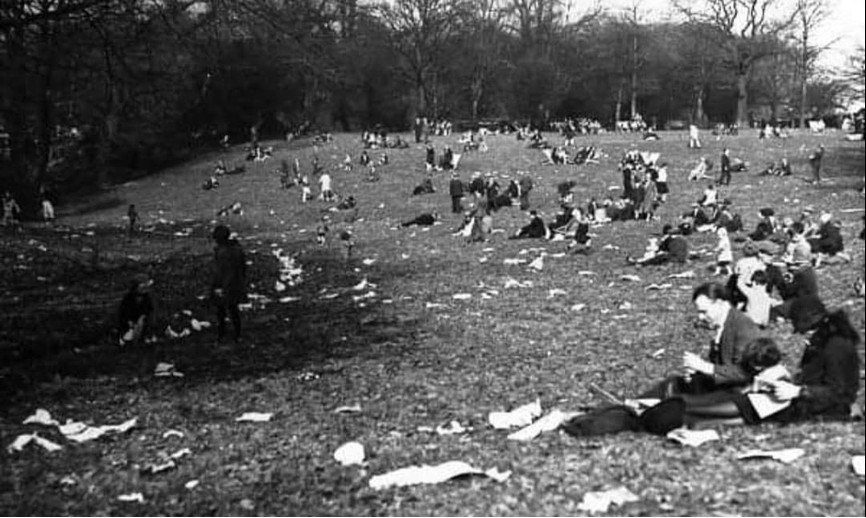
This is a photograph of Hampstead Heath in London in the 1930s, and as we can see, litter was a real problem.