The History of Fog Lane Park - Making Savings in 1931
The Great Depression of 1929 was still having a big impact on the economy and employment and as a result, life was still very hard for many families in Manchester. Charitable groups did what they could to improve the lives of children and families affected, and one such group was the Beswick Cooperative Society, based in Ancoats. On 1st May 1931 the Parks Superintendent received a letter from the secretary of the Society asking permission to hold a Field Day in Fog Lane Park on the afternoon of Saturday 25th July. A Field Day was basically, a very basic sports day, where the children were encouraged to take part in simple races, such as sprinting, relays and the sack race and other group games, such as tug-of-war, hoop rolling and skipping with long ropes, the aim being to encourage physical fitness, team spirit and social involvement. The local community would come out to watch, cheer and celebrate the children. In their letter, the secretary stated: ‘There will be a good number of workers to control the children, and the races organised for them. It is proposed to provide them with refreshments during the afternoon, in a marquee.’ Naturally, the Parks Committee gave their assent when the matter came up at the next meeting.
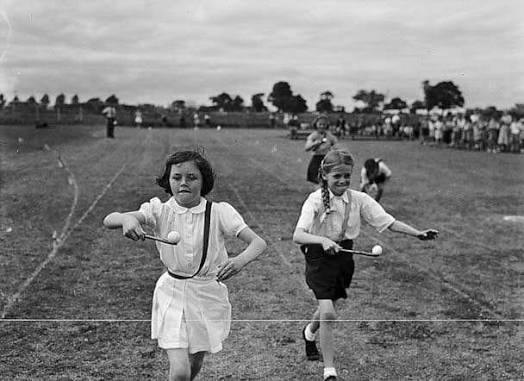
Egg and spoon race. Courtesy of Facebook
It wasn’t only families who were feeling the pinch; progress is a great thing, but wasn’t always good for everyone as the following letter shows. On 8th May 1931, the Parks Committee had received a letter from the Musicians’ Union asking permission to introduce a scheme: ‘to assist unemployed professional musicians and their families during the present crisis in our profession, the principal cause of which is the introduction of “Talkies” and mechanical music.’ The musicians wanted permission to set up a series of concerts in Manchester parks over the summer ‘which we think might be successful in alleviating to some extent the distress now prevailing.’
The Committee no doubt discussed this at some length, but, for whatever reason: ‘the Committee regret they are unable to agree to the proposal’
It was now time to order bulbs for the spring and at the Parks Committee meeting on the 12th June, the various tenders from the Dutch bulb farms were considered. The previous year, they had planted out 189,000 bulbs, but this year they were planning on purchasing 200,125. Last year, they had spent £767, but this year, despite buying more, they were planning on spending less than half that amount. They had received a tender from Schermer & Sons for £348 19s 8d, which was the lowest tender from the 22 firms who had been approached and now instructed the General Superintendent to visit Holland and if satisfied, to accept the tender. If he was not satisfied, he was authorised to look at the next lowest tender.
Another modernisation was discussed at the Parks Committee meeting of 26th June 1931. The General Superintendent reported that now that there were so many school and park playing fields to mow, it was difficult to cope with the work with the existing horses. He suggested: ’it would be an economical proposition to purchase a tractor for drawing the “Triplex” machines. Such a tractor can be purchased with a body capable of carrying the mowing machine from place to place and this would be a very great advantage. It would result in the saving of a considerable amount of horse labour besides expediting the work of mowing the fields. A tractor with a new “Ford” engine and a tipping body can be purchased for the sum of £251. 0. 0.’
The suggestion was approved and horses were on the way out.
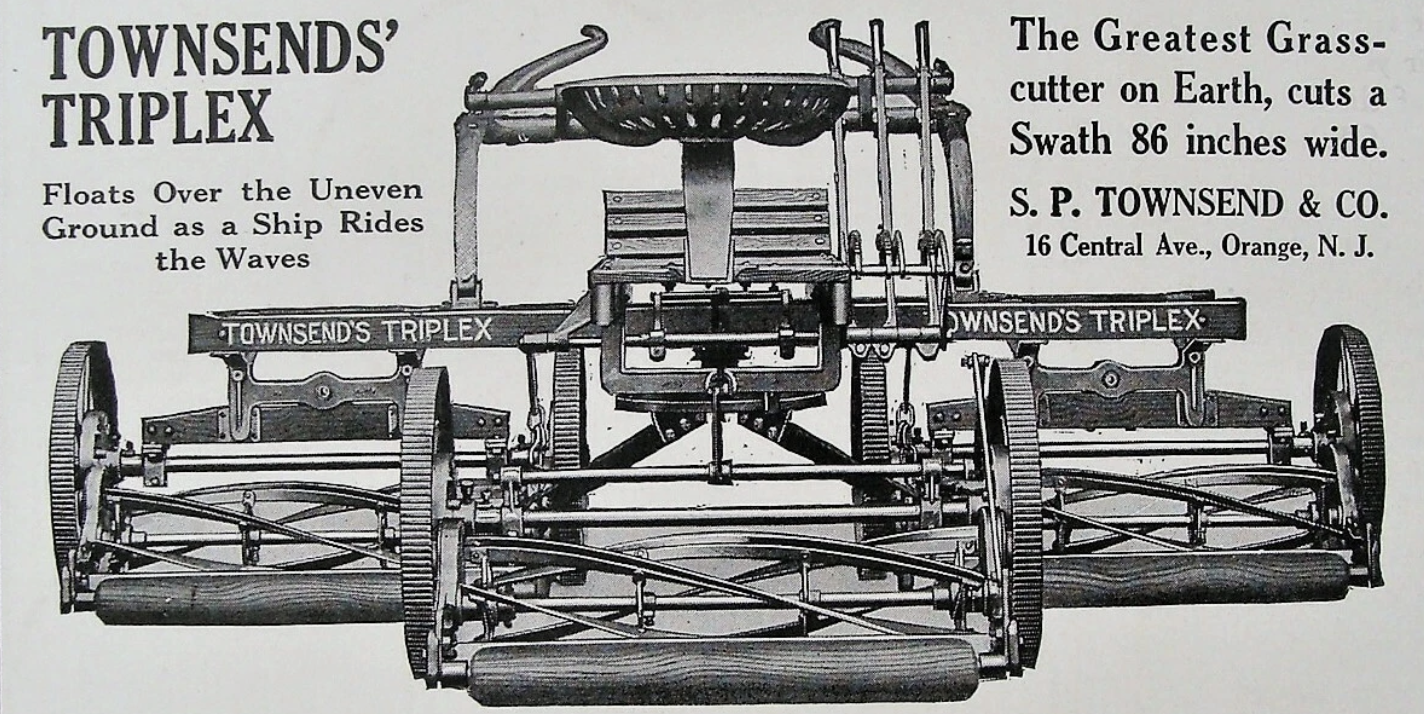
An advert for a “Triplex” machine similar to those that were used to cut the grass in Fog Lane Park
It wasn’t only those who were out of work who were being affected by the depression, the economic slow-down was affecting everybody. At the meeting of the Parks Committee on the 16th October 1931 they were told that the City of Manchester had to reduce expenditure and therefore it had been decided to cut the salaries of all the employees of the local authority. This was a graduated cut, starting at 2% for those on the lowest salaries, or the first £100 of a salary, going up by 1% for every further £100 of salary and reaching a peak of 10% for the excess of all salaries over £1000. At the meeting they were presented with a chart to enable them to see how it would affect everyone. For example, someone on a salary of £100 pa would lose £2, whereas someone on a salary of £500 pa would lose £19, rather than £10. Mr Pettigrew, who was on a salary of £1041 pa, would have stood to lose roughly £61, rather than £20 if it had been a straight 2%. There is nothing in the Minutes to say what they felt about that, except to state that it was approved.
The Parks Committee must have been happy to move on from that item to the end of season parks report. The report stated that it had been a very poor summer until the very end, when the weather improved: ‘Since the early days of September the appearance of the flower borders in most of the parks has gradually improved until recently they have been quite as gay and interesting as in former years. The show of roses at Chorlton, Fog Lane, Alexandra and Heaton Parks have been the pride of Manchester residents.’
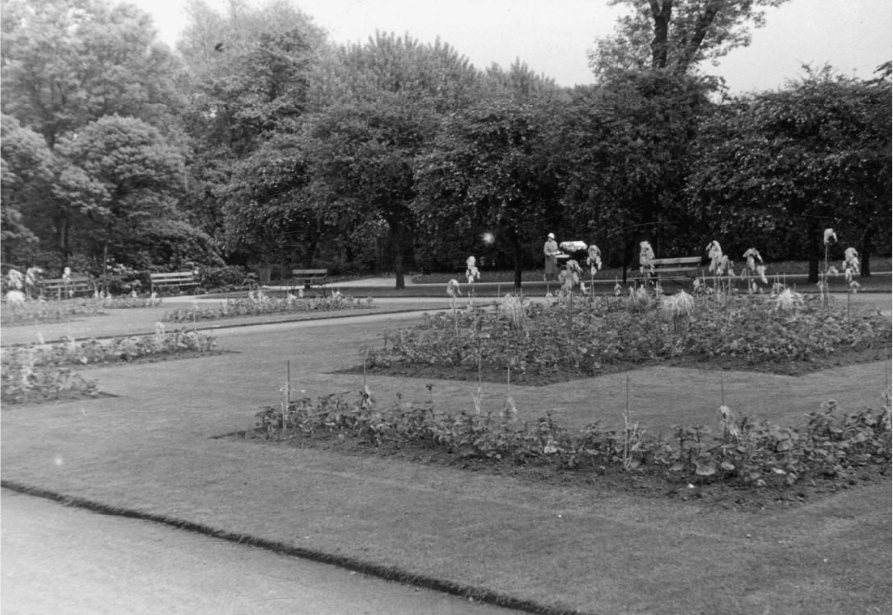
Flower beds in Fog Lane Park. Image courtesy Manchester Libraries
At the following meeting on 30th October, Mr Pettigrew reported that he had received a letter from Mr C. E. Stewart of the Education Offices, Blackburn, who lived in Manchester and was a dog owner: ‘Mr Stewart suggests that your Committee might re-consider the bye-law with regard to the control of dogs in the parks with a view to enabling dog owners to give their animals free exercise, if possible, in all parks and at all times. If the lay-out of certain parks would not allow of this, then the other parks might be made available. He suggests as instances Birchfields and Platt Fields. He points out that as dogs are allowed to run loose in the streets there can be no objection on the ground that it is dangerous for them to run loose in the parks.’
After discussion, the Committee resolved: ‘That in future, dogs be not allowed to run about loose in any of the various parks’
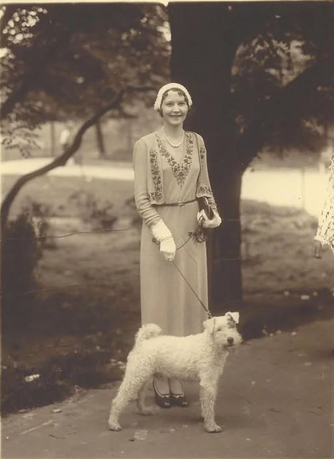
A dog walker in a park, maybe from the 1920s or 1930s. Image courtesy of Facebook