The History of Fog Lane Park - Dancing in the Park
Mr Richardson had taken over as General Superintendent of Parks and Cemeteries in 1933 at a time when Manchester Council was having to make savings. They didn’t know this at the time, but the Depression was probably at its worst in 1932, and by 1933 economic recovery had already begun in the South of England, although it was a different story in the North.
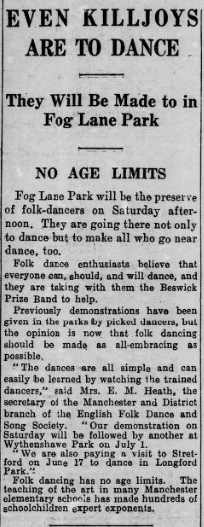
At the meeting of the Parks and Cemeteries Committee on 3 March 1933, Mr Richardson reported that he had received a letter from the Manchester and District branch of the English Folk Dance and Song Society asking for permission to use Fog Lane Park for a display of folk dancing on Saturday 27th May. The Committee were all for it. It was free entertainment that wasn’t going to cost the Council anything. The Manchester Evening News wasn’t quite so enthusiastic - see the article below.
At the same meeting, the Committee considered a letter from the Manchester and District Pansy and Viola Society requesting permission to use: ‘a small plot of ground in one or two of the municipal parks for the purpose of holding a trial of varieties of Pansies and Violas. The Society would provide the plants required for the trials and anticipate they would be able to supply about fifty varieties, all correctly named. The objects of the Society are to encourage the growing, improving and exhibiting of these popular flowers and also to encourage the raising of new varieties.’ They were asking for a small area of land, probably not more than a hundred square yards. Mr Richardson suggested that the Committee agree to the request. The trials could be held at Heaton Park and Fog Lane Park, which, as they are at opposite sides of the city, would be more convenient for those interested to inspect the plants than if they were in just one park. He does not say this to the Committee, but I’m sure that beds of free violas and pansies were very welcome at this time. The Parks and Cemeteries Committee approved the proposal.
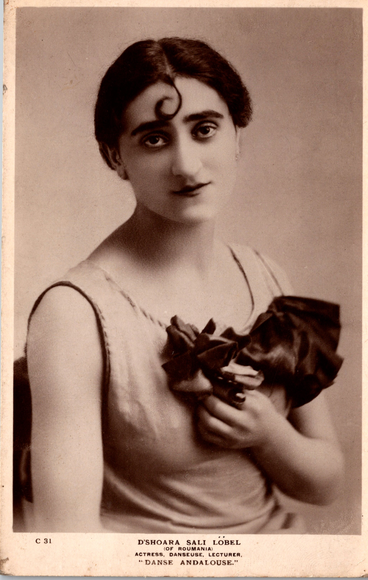
The following month, the Parks Committee received a letter from the Sali Lobel Studios, based on Oxford Road. Sali Lobel was a Romanian actress and dancer (see photo below) who had opened a dance school in Manchester where she taught classes in dancing, elocution, singing, piano, violin and fencing. In March 1933, she had the idea of setting up health and physical fitness classes for women which became known as ‘The Everywoman’s Health Movement’. The movement had taken off so quickly in Manchester, that new premises had to be found to cater for the hundreds of women who wanted to sign up. Here is a description of the movement from the Burnley Express 20 May 1933:
’There is no apparatus…Each class lasts one hour and every exercise is prefaced by an explanation of the reason and the effect. They are based on the anatomical construction of the body, and have been divided into sections, as follows: A, abdomen; B, balance; C, circulation; F, feet; G, graceful walking; H, head; L, legs and hips; S, spine; SH, shoulders and hands; W, waist. These ten exercises bring in every section of the body, and members have to promise to do ten minutes’ physical practice and five minutes’ breathing exercise each day…. All the exercises are done to music, and each exercise has its own special tune…The movement is sweeping throughout the country, and Miss Lobel has, during the past few days, been urged to start a branch in Birmingham. Branches are being started in Bolton, Oldham, Warrington and Huddersfield. In Manchester, Miss Lobel has had the support of the education authorities and also of several large firms who recognise the value of keeping their employees fit.’
Flushed with the success of her new venture, Miss Lobel wrote the following letter to the Parks and Cemeteries Committee:
‘Dear Sirs
We beg to draw your attention to the enclosed pamphlet, which is the first and promises to be the biggest health movement in the north of England.
We notice that the English Folk Dancing Society are to give performances in the parks during the summer and we would naturally like to make the same arrangements for this movement, which is one that will encourage racial health in a radical form.
We shall be glad to hear from you and trust that you will give the matter due consideration.’
The Committee gave the matter due consideration and responded: ’That the application now made be not entertained’
Folk dancing was one thing, radical health movements were quite another, despite the fact that Lady Simon was a patron.
The following year, on 23rd March 1934 Sali Lobel tried again:
‘You will no doubt remember that about this time last year I approached the Parks Committee with a view to a demonstration in the parks by our Health Movement. At the time the idea was of course new, and we had not shown what we could do, but now after twelve months, when we have achieved so much, nearly 2000 members in Manchester, and seven branch towns, perhaps the Committee would consider the idea of this sometime.’
The Committee considered the idea again and resolved: ’That the offer now made be refused.’
No park of theirs was going to have women playing leapfrog, or prancing around with bowls balanced on their heads! The photo below shows an example of a dance competition organised by Sali Lobel’s health movement.
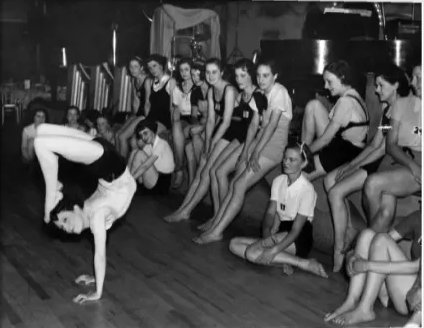
Sali Lobel dance competition 6 Oct 1936 Courtesy of Mirror Group
Other requests, however, were treated more favourably. The Withington Branch of the League of Nations Union were granted permission to hold an evening meeting in Fog Lane Park on Tuesday 25th July 1933. The League of Nations Union had been formed at the end of the First World War and aimed to promote international justice and permanent peace between nations. Membership in Manchester and nearby districts was claimed to be about 25,000 organised into 72 Branches, of which the Withington Branch was one.
Having been granted the meeting, there was then a follow-up letter from the Withington Branch with the following request:
‘The Lady Mayoress has graciously consented to preside at the public, open-air meeting which is to be held in Fog Lane Park on Tuesday, July 25th 1933 at 8p.m.
In view of her presence on this occasion in a City Park, the Committee feel that there is only one place in the park where the Lady Mayoress could be fittingly received and that is the Bandstand.
We are sure that this feeling will commend itself to you too, and that you will be as anxious as we are to provide the most beautiful setting possible for the Lady Mayoress, and that, in these special circumstances, you will be kind enough to waive the fee.’
The Committee considered this, but then decided that they: ‘regret that they are unable to grant his application for the free use of the bandstand.’
Despite this, the meeting went ahead with an attendance of over 900.
In July 1933, Fog Lane Park hosted the annual inter-City tennis matches between Sheffield and Manchester. Once again, Manchester proved too good for Sheffield, although some of the matches had been very close. However, what really impressed the Sheffield visitors, was the quality of the sports facilities, as an article in the Sheffield Star Green’Un on the 29 July made clear:
‘The match was played at Fog Lane Park, one of Manchester’s wonderful sports grounds…. There are two rows of tennis courts, both hard and grass, 14 courts in each row. The surface was in perfect condition, being firm and absolutely clean. Each court had a lot of room behind the base line, probably 20 to 25 feet being the distance from the base lines to the netting.
Around this vast expanse of tennis courts were large beds of flowering plants laid out on beautiful green turf. In addition, there is a splendid pavilion, with private rooms for ladies and men to change in. All the interior is tiled with white tiles and lit by electricity. There are few such places in the whole of Sheffield’
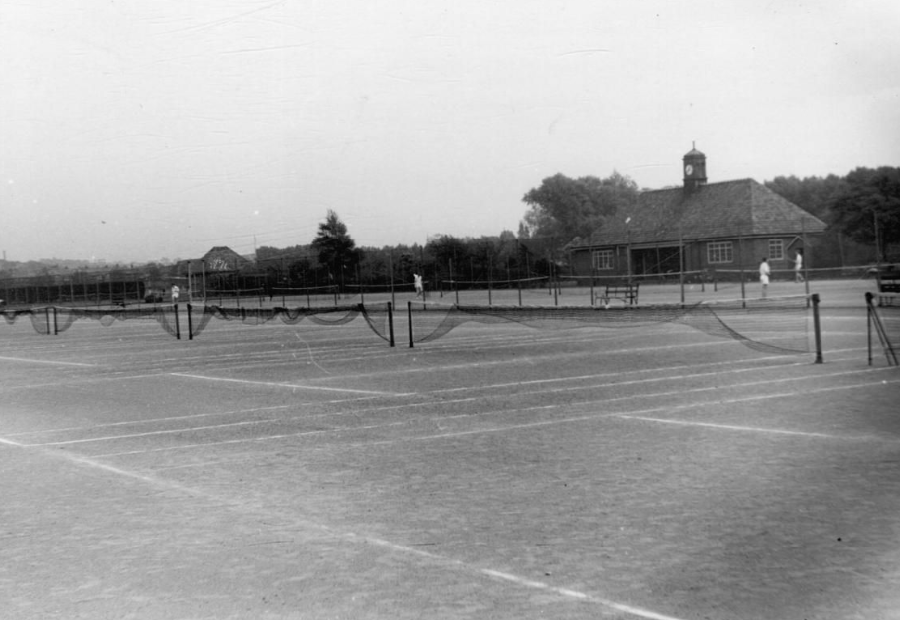
Image courtesy of Manchester Libraries
Although the photo above was taken in 1962, I can count 18 tennis courts in the photograph, still in two rows and continuing into the area which is now the children’s playground. I would imagine that they extended off to the right of the photograph as well, covering the area now taken up by the basketball court and skatepark, so there might well have still been as many as 28 courts in 1962, although probably not in as good a condition as in 1933.
Cycling in parks, however, was not allowed. At the meeting of the Parks Committee on 21 September 1934 the General Superintendent reported that:
‘…during the past month 26 persons have been proceeded against for cycling on the footpaths in various parks. In each case the persons were convicted and fined 2/6.’
At the Parks and Cemeteries Committee meeting on 19 Oct 1934, Mr Richardson presented his annual report on the flowers in the parks:
‘The past season was an abnormally dry one. A dry winter and spring was followed by a prolonged summer drought which continued to about the end of July. Many shallow rooting plants suffered from the drought, but, nevertheless, it has been a wonderful season for bloom…. Roses flowered exceedingly well at Heaton Park, Fog Lane Park and Chorlton Park, and, in fact, there are many good blooms to be seen at the present time. Dahlias provided a good show at the majority of the parks, and owing to the absence of early frost are still continuing to do so.’ Life carried on, but the storm clouds were gathering.
© 2026 Friends of Fog Lane Park. All Rights Reserved.